
Foundation Repair in Marietta, GA
We work Marietta the way a local plumber works Marietta — one neighborhood at a time. East Cobb ranches. Kennesaw Mountain slope-lot homes. Marietta Square historic brick. The soil, the era of construction, and the failure patterns are different in each, and this page tells you what we actually see.
Licensed & insured in Georgia · Cobb County crews, not a franchise dispatch
East Cobb, Kennesaw Mountain, and Marietta Square.
Most of our Marietta calls come from three pockets. East Cobb — the Sprayberry, Indian Hills, Sope Creek, and Walton High feeder area — is our highest volume. It's 1965–1985 ranches and split-levels on shallow footings, poured straight into Piedmont red clay, now four decades into cycling. Kennesaw Mountain and the Burnt Hickory / Stilesboro corridor is a different animal — steeper lots, decomposed granite under thin topsoil, and drainage-driven differential settlement. Marietta Square, the Church-Cherokee Historic District, and Whitlock Avenue give us the third pattern: 1900–1930s pier-and-beam brick with original masonry perimeter walls that need crawlspace and vapor work as much as structural.
Piedmont red clay, shallow bedrock, and elevation swings.
Marietta sits at roughly 1,100 ft elevation on the Piedmont plateau, higher and drier than intown Atlanta. Under most lots is 3–8 ft of expansive red clay (Cecil and Madison series) over saprolite and decomposed granite. That clay has a plasticity index high enough to move visibly with seasonal moisture — swelling in wet winters, shrinking away from footings in droughts like 2007 and 2016. On the Kennesaw Mountain side, clay depth drops to 1–2 ft over rock, which creates hard pin-points that don't move while adjacent soft spots do. That's why so many Marietta cracks are diagonal rather than horizontal.
1965–1985 ranches, 1990s two-stories, historic brick pier & beam.
East Cobb's dominant stock — the Sprayberry, Lassiter, and Pope feeder ranches — was built with shallow monolithic slabs or short crawlspaces on 8" footings that were adequate for 1970 but leave no reserve for today's storm cycles. West Cobb's 1990s–early 2000s two-stories (Barrett Parkway, Stilesboro, Legacy Park) are cut-and-fill sites where fill compaction quality varies house-to-house. Historic Marietta homes near the Square are almost always pier-and-beam on brick or stone masonry, and the failure mode is usually crawlspace moisture, sagging joists, and mortar deterioration — not the slab issues that dominate the suburbs.
The four repairs Marietta homes actually need.
Slab repair
Cracked and settling slabs on East Cobb ranches and West Cobb two-stories.
Pier & beam
Helical piers, sistered joists, and crawlspace work for historic Marietta.
House leveling
Elevation surveys and staged lifts to bring settled corners back within tolerance.
Drainage & grading
The upstream fix — gutter extensions, French drains, and regrading against the foundation.
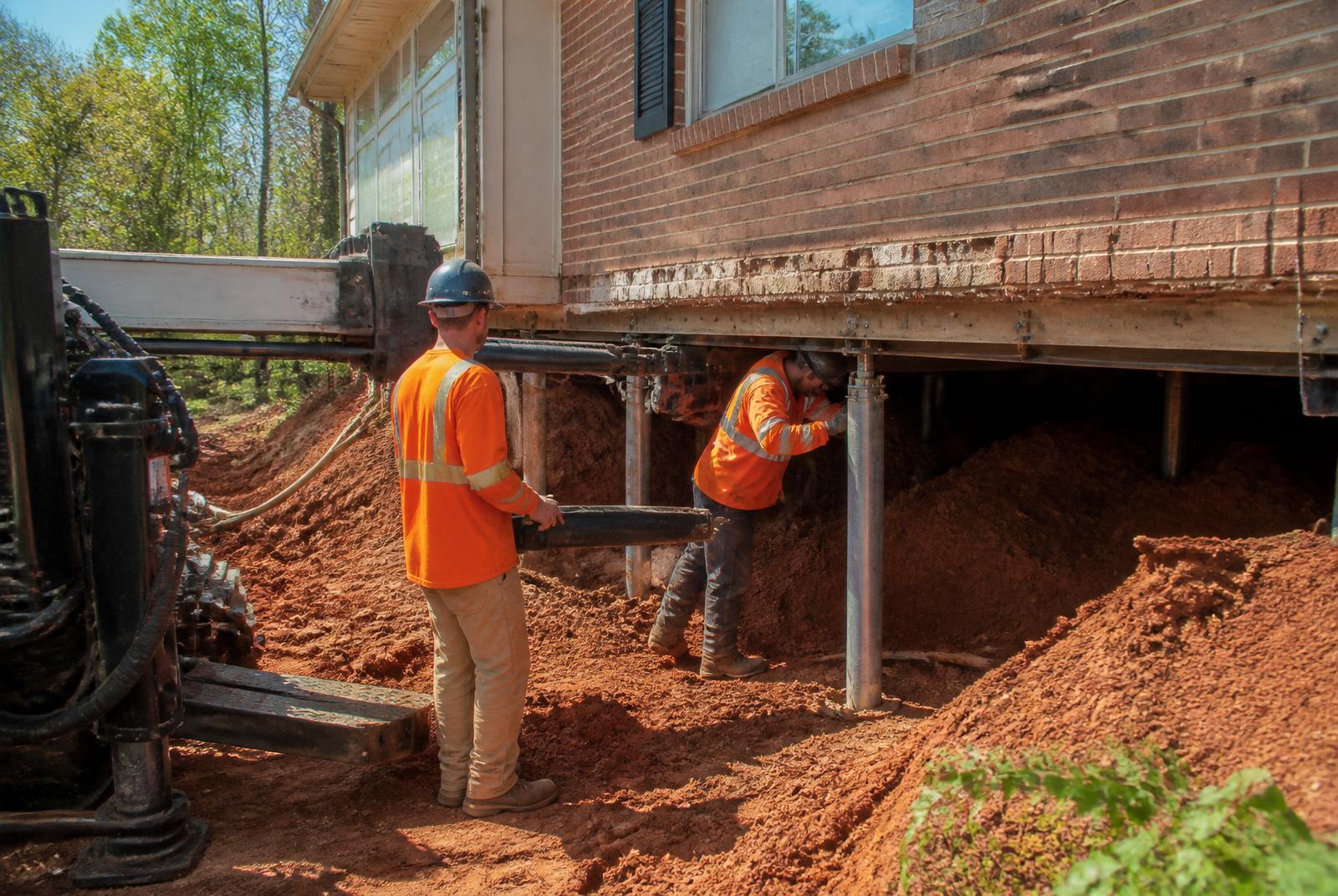
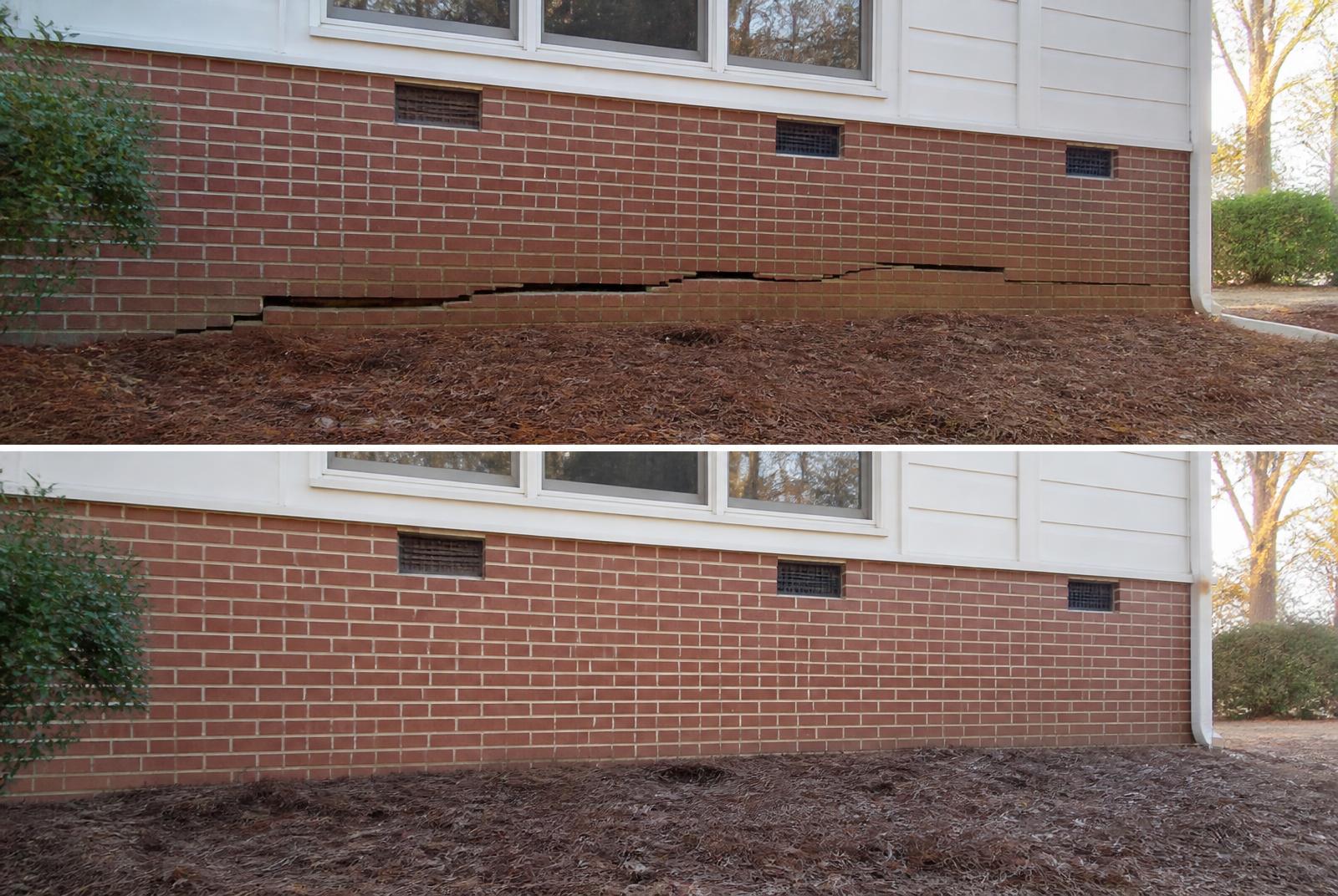
Real Marietta jobs, not stock photos.
Questions we actually get from Marietta homeowners.
Why do so many East Cobb ranches have foundation problems?+
Most of East Cobb was built between 1965 and 1985 on shallow footings poured directly into Piedmont red clay. That clay swells and shrinks aggressively with seasonal moisture. After 40+ years and multiple drought cycles, the corners and long runs settle unevenly — which is why you'll see the classic diagonal drywall cracks over doorways in Sprayberry, Sope Creek, and Indian Hills homes.
My house is on a slope near Kennesaw Mountain. Is that the cause?+
Often, yes — but not the way people assume. It's rarely the slope itself. It's the drainage. Homes on the Kennesaw Mountain foothills sit on thin topsoil over decomposed granite, and roof runoff has nowhere to soak. Water sheets against the uphill side of the foundation, saturating one side of the footing while the downhill side dries out. That differential is what cracks the slab. Grading and gutter extensions solve most of it before piering is needed.
I have a historic home near Marietta Square. Do you work on those?+
Yes. Homes in the Church-Cherokee Historic District, Whitlock Avenue, and around the Square are typically pier-and-beam brick with masonry perimeter walls on original 1900–1930s footings. We stabilize with helical piers when needed, but the first move is almost always crawlspace evaluation — vapor barrier, moisture, sistered joists — before touching the exterior brick.
How much does foundation repair in Marietta typically cost?+
For a Marietta home the honest range is $3,500 for a targeted drainage-plus-crack-injection job on a healthy slab, up to $18,000–$25,000 for a full perimeter helical pier lift on a settled East Cobb ranch. Most inspections we run end with no repair recommended at all — just monitoring. We give you a written scope, not a scare quote.
Davies Foundation Repair — Marietta, GA
- Business
- Davies Foundation Repair
- Phone
- (000) 000-0000
- Service area
- Marietta, GA and surrounding Cobb County
- Hours
- Mon–Sat, 8am–6pm ET
- What we do
- Foundation inspection, slab repair, pier & beam repair, house leveling, and drainage correction for Marietta and Cobb County homeowners. Local crews. Written scopes. No franchise dispatch.
Service-area business — we come to your home. No physical storefront.
Not in Marietta? Try a neighboring suburb.
Smyrna
1960s ranches, Vinings-adjacent slopes.
Kennesaw
Kennesaw Mountain foothills, Legacy Park.
Cobb County hub
All Cobb suburbs we cover.
Book your free Marietta inspection.
Tell us the neighborhood and what you're seeing. We'll come look, take measurements, and give you a real answer — even if the answer is "you're fine."